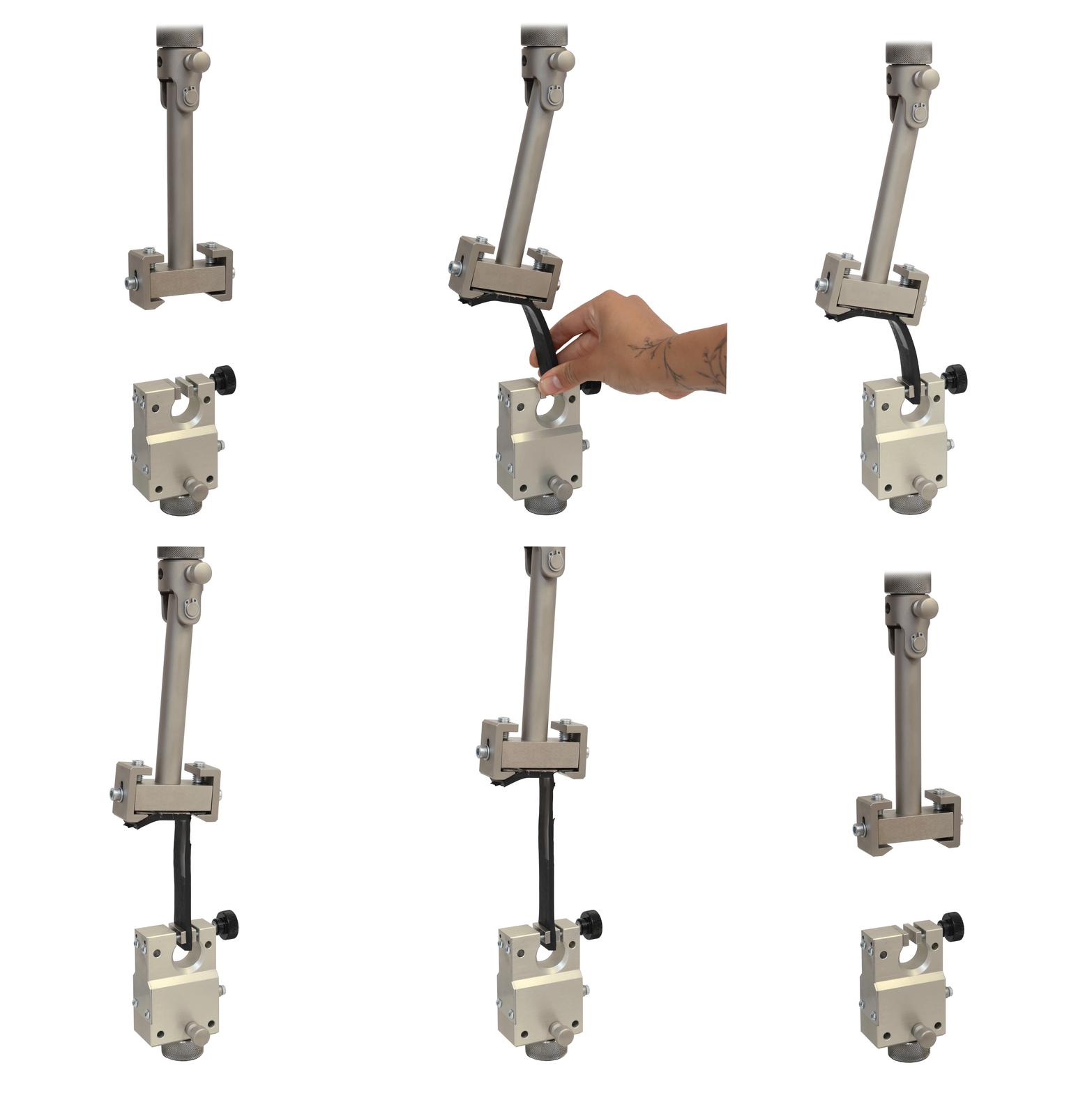
ASTM D3039 Tensile Testing of Polymer Matrix Composite Materials
Advanced composite materials, such as reinforced polymer matrix composites, have been identified as an essential growth factor in U.S. manufacturing. Their desirable light weight combined with high stiffness and strength make polymer matrix composites attractive to many industries, especially the aerospace industry.
What Is ASTM D3039?
ASTM D3039 is a standard test method for the tensile properties of polymer matrix composite (PMC) materials.
Why Use ASTM D3039?
ASTM D3039 is a helpful guide when testing polymer matrix composite materials reinforced by high-modulus fibers. ASTM D3039 determines the tensile properties of the composite for research and development, quality assurance, and structural analysis and design. The standard asks for a thin flat strip of material having a constant rectangular cross-section to be mounted in the grips of a universal testing machine. The tests must be performed a minimum of five times per specimen. Tensile properties are measured using stress strain relationships that are the results of ASTM D3039 testing.
What Test Machines Are Commonly Used to Perform ASTM D3039?
A Universal Test Machine is used for performing ASTM D3039. The required force capacity depends on the specific material, sample size, and expected tensile strength. This can vary significantly depending on your material type and specimen dimensions. Start by selecting a machine that has an appropriate force capacity for the strength of the composite material you are testing.
How Do I Determine The Force Capacity I Need for ASTM D3039?
Consider these factors when determining the appropriate force capacity that you need.
- Determine the Maximum Tensile Strength of Your Specific Material
The force capacity of a test machine is primarily determined by the maximum tensile strength expected for the composite material being tested. This crucial value is typically found in the material's datasheet or specification, providing essential information about the material's strength characteristics.
Understanding the maximum tensile strength ensures that you get a test machine that has sufficient force capacity to accurately evaluate the material's performance. - Determine Your Specimen Dimensions
ASTM D3039 outlines the standard specimen dimensions for accurate and reliable testing. The specimen's cross-sectional area determines the force required to reach failure. Larger specimens need higher force to induce failure. - Determine Your Desired Safety Factor
When selecting a machine, it is recommended that you choose one with a force capacity that exceeds the estimated maximum load by 20-50%. This practice accounts for potential variations in material properties that may not have been initially anticipated. By incorporating this safety margin, the integrity and longevity of the equipment can be better ensured, minimizing the risk of overloading or premature failure. - Determine Your Material’s Fiber Orientation
It’s important to take into consideration that composites exhibit anisotropic behavior, which means their properties vary depending on the direction. When the fibers are aligned with the loading direction, the material becomes stronger and requires a higher force to cause failure.
Example: How to calculate the force capacity required for a carbon fiber composite
If you were testing a carbon fiber composite with an expected tensile strength of 1000 MPa and using a standard specimen with a width of 15 mm and a thickness of 2 mm. You would calculate your force capacity using a calculation like this:
- Calculate the cross-sectional area: Area = width x thickness = 15 mm x 2 mm = 30 mm²
- Estimate the maximum load: Maximum Load (N) = Tensile Strength (MPa) x Cross-sectional Area (mm²) Maximum Load (N) = 1000 MPa x 30 mm² = 30,000 N
- Apply a safety factor of 30%: Required Force Capacity (N) = 30,000 N * 1.3 = 39,000 N
For this specific example, you would need a testing machine with a force capacity of at least 39 kN.
Get a Complete Test System for Your Test Application
Completing your material test system is easy. Simply start by choosing a test machine, choose your accessories, and select your controller software. We are your one-stop shop for all your application testing needs.
Request a QuoteNewton Test Controller
From simplified test setups to an intuitive controller software interface and pre-configured methods for industry standards - this innovative technology ensures that your test application are conducted seamlessly and with precision.
Accurate & Repeatable Test Results
- Simple test setup, operation, and reporting
- Flexible and scalable software packages - Get what you need now with room to grow!
- Prebuilt test methods for many of the most common application-specific testing standards
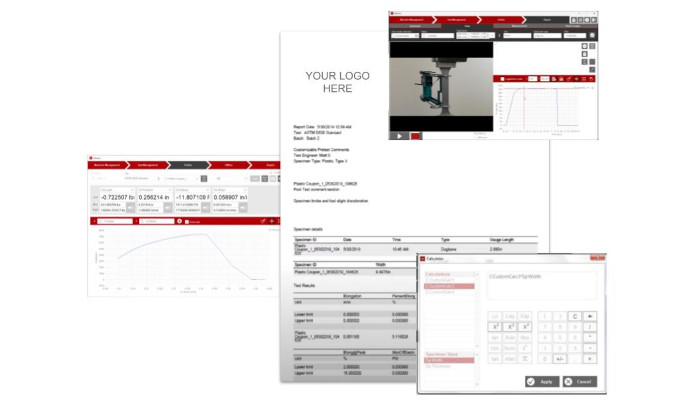
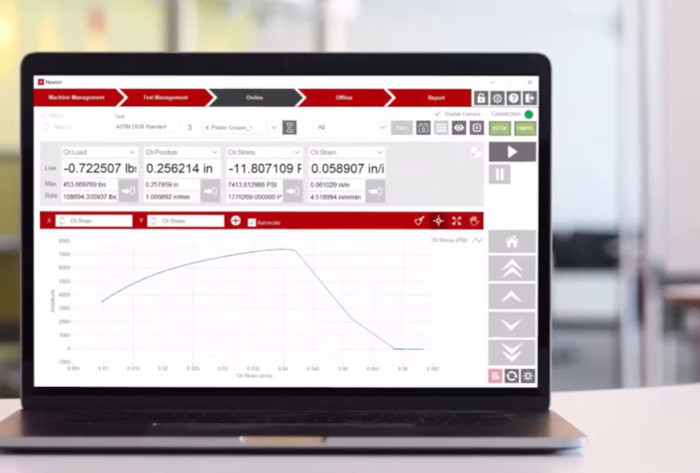
High-performance and easy-to-use controller with logical workflow design
With an intuitive interface, Newton makes it easy for users to navigate through various options and settings, ultimately enhancing the overall user experience. By streamlining complex procedures into user-friendly steps, this software serves both experienced test engineers and beginners alike to conduct tests with confidence and accuracy.
How Fast Does Data Need to Be Acquired?
Per ASTM D3039, tests can range from a few hertz (Hz) for slower tests to several kilohertz (kHz) for high-speed tests. It is important to consult the specific requirements of your testing equipment and the material being tested to determine the most appropriate rate of acquisition.
Composite materials can fail rapidly, so high-speed stress and strain measurement is necessary to capture the load-displacement data accurately. Newton Universal makes this easy. Newton captures stress and strain data at speeds in excess of 5 kHz.
Test Analysis, Calculations & Reports for ASTM D3039
Get the right test reports and calculations with our Newton controller!
ASTM D3039 requires several calculations and test results to determine the material's mechanical properties and ensure compliance with the standard. To fully comply with ASTM D3039, our Newton control system provides a comprehensive suite of calculations and test results. This includes determining the ultimate tensile strength, tensile modulus of elasticity, Poisson's ratio, and percent elongation at break.
Important Calculations
Tensile Strength
- Ultimate Tensile Strength (UTS) represents the maximum tensile stress a material can withstand before failure occurs. It is determined by dividing the maximum load applied to a specimen by its original cross-sectional area.
- Yield Strength (if applicable) applies to certain materials, particularly metals and alloys. It refers to the stress level at which the material exhibits a specified deviation from the linear relationship between stress and strain.
Modulus of Elasticity
- Tensile Modulus measures the resistance to elastic deformation under tensile stress. A higher tensile modulus indicates a stiffer material, which requires a greater force to produce a given amount of deformation.
- Chord modulus measures the stiffness of a material within a specific range of strain. This provides valuable information about the material's resistance to deformation under applied loads within the defined strain interval.
Poisson's Ratio (Optional)
- Poisson's Ratio measures the relationship between the axial and transverse strains experienced by a material under load. It measures the degree to which a material contracts or expands laterally when subjected to axial loading. Poisson's Ratio is determined by measuring the axial and transverse strains using strain gauges or extensometers attached to the specimen in both the axial and transverse directions.
Ultimate Strain
- Elongation at Break is a measure of the ductility of a material, expressed as the percentage increase in gauge length at the point of specimen failure. It is calculated by taking the final length after fracture, subtracting the initial length, dividing by the initial length, and multiplying by 100%.
ASTM D3039 Test Results
Load-Displacement Curve
This curve provides valuable insights into the material's behavior under tensile loading conditions. It visually illustrates the relationship between the applied force and the corresponding deformation, allowing for the analysis of key material properties such as stiffness, yield strength, and ultimate tensile strength.
Stress-Strain Curve
This graph represents the relationship between stress and strain, plotted using calculated stress values on the y-axis and measured strain values on the x-axis. This is essential for determining tensile strength, yield strength, and modulus of elasticity.
Failure Mode
This provides valuable insights into how the specimen failed, including the location and type of failure (e.g., fiber breakage, delamination, matrix cracking).
The standard may require reporting additional data like specimen dimensions, test speed, environmental conditions, and equipment details, which can easily be done with Newton.
Get all this and more with Newton!
Due to the massive selection of products that we offer, it can be difficult to narrow down what you need. Let us help you select and configure based on your testing application.
ASTM D3039 Accessories
Choose from 100's of standard test accessories as well as custom solutions. All of our grips and fixtures will fit any brand of test machine through the use of an adapter.
How Do I Select the Best Grips?
Deciding which grip to use can be challenging but our engineers are here to help you get the right grip for your sample. These are the common factors you should take into consideration when choosing grips for tensile testing according to ASTM D3039: Material, surface characteristics, alignment requirements, grip type/features, and capacity requirements.
What Are the Test Sample Gripping Challenges?
- Carefully consider the material properties, specimen dimensions, and testing requirements when selecting the most suitable grip type for the given application. Different materials and sizes dictate which grip is needed. Selecting the wrong grip can cause inaccurate results and premature failure.
- Composite materials, particularly those with smooth fiber surfaces or low resin content, can exhibit slippery characteristics. This slipperiness poses a challenge during testing as insufficient friction between the grip and the specimen may cause it to slip, resulting in inaccurate test results or premature failure of the specimen. It is important to ensure adequate grip friction to obtain reliable and accurate data from composite material testing.
- Excessive grip pressure can induce localized damage to the specimen, particularly in the grip area, leading to premature failure. This issue is more common with brittle materials.
- If the grips are not properly aligned, the specimen will experience bending stress in addition to tensile stress.
What Are the Different Types of Tensile Grips for ASTM D3039?
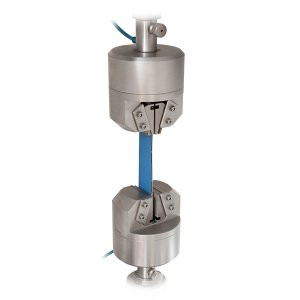
- Mechanical Wedge Grips: These are the most common type of grip used for ASTM D3039 testing. They use a wedge-shaped jaw to clamp the specimen, and the gripping force increases as the specimen is pulled. Wedge grips are suitable for a wide range of composite materials and specimen geometries.
We recommend the G527 Wedge Grip.
- Hydraulic Wedge Grips: These grips use hydraulic pressure to clamp the specimen. They offer precise control over the gripping force.
We recommend the GX Hydraulic Grip.
- Pneumatic Wedge Grips: These grips use compressed air to clamp the specimen. They are similar to hydraulic grips but are generally less expensive and can be used for delicate or sensitive materials.
We recommend the G175 Pneumatic Grip.
- Mechanical Screw Action Grips: These grips use a screw mechanism to clamp the specimen. They are simple and inexpensive but may not offer as much precision as other types of grips.
We recommend the G90 Mechanical Vice Grip.
Choosing the Right Jaw Faces for Your ASTM D3039 Grip
- Serrated Faces: Recommended for most composite materials to provide a secure grip and prevent slippage.
- Flat Faces with Emery Cloth: Recommended for some composites, especially those with smooth or slippery surfaces, flat faces with a layer of 80-grit emery cloth. The emery cloth should be replaced regularly to maintain its effectiveness.
- Rubber-Coated Faces: Recommended for delicate or thin composite specimens to prevent damage to the material during gripping. Note: Rubber coating can degrade or lose its gripping ability over time, so check it periodically.
ASTM D3039 Strain Measurement
Even though ASTM D3039 doesn’t require an extensometer, it is recommended for an accurate measurement of the tensile modulus. If you have a variety of sample sizes, thicknesses, and surface textures it can be hard to get an accurate measurement of the tensile modulus. In this case, a non-contacting strain measurement tool may be recommended.
How to Select Your Extensometer
There are three types of extensometers used for ASTM D3039, each with its own advantages and disadvantages depending on the specific testing requirements:
- Clip-on Extensometers (Most Common)
- These are the simplest and most common type of extensometer used for ASTM D3039.
- They are attached directly to the specimen at a fixed gauge length.
- Easy to use and relatively inexpensive.
- Can be used for both axial and transverse strain measurements.
- Limitations include potential for specimen damage and limited temperature range.
We recommend the 3542 or 3442
- Strain Gauges
A strain gauge can utilize the Newton strain channel with the addition of an optional Newton bridge completion module. Strain gages, supplied by the customer, can be used to measure strain in ASTM D3039 and have these attributes:
- Bonded directly to the specimen surface.
- Measure strain by changes in electrical resistance.
- Requires careful installation and calibration.
- Potential for self-heating and influencing specimen behavior.
- Are consumable.
- Cannot measure strain at failure.
- Can be an alternative or complement to clip on extensometer.
- Least expensive solution
Ask about our Newton bridge completion module
- Non-Contacting Video Extensometers:
A non-contacting video extensometer is recommended if you have a variety of sample sizes, thicknesses, and surface textures which can make it hard to get an accurate measurement of the tensile modulus.
- Use advanced image processing to track specimen deformation.
- Eliminate contact, preventing damage to delicate specimens.
- Ideal for testing in non-ambient conditions (e.g., temperature chambers, fluid baths).
- More expensive than clip-on extensometers.
Ask us about Newton TestVE
In some cases, the crosshead displacement of the testing machine can be used as an estimate of strain. However, this is less accurate than using an extensometer due to factors like potential machine compliance and grip slippage.
Talk to one of our Engineers to help you navigate the vast selection of testing accessories to find the perfect fit for your testing application.