ISO 594-1 & 2 Separation Force and Unscrewing Torque Testing for Luer Tapers

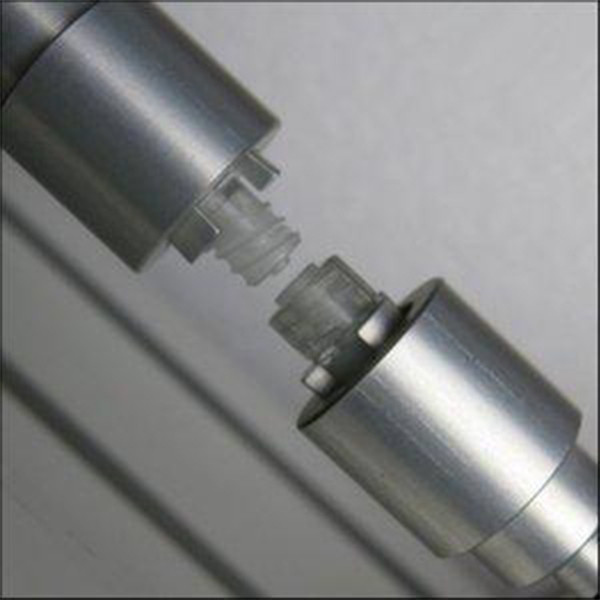
The Luer taper is a standardized system of small-scale fluid fittings for making leak-free connections between sections on medical and laboratory instruments, including hypodermic syringe tips, catheters and infusion devices. ISO 594-1 is the standard specification and test method for the design of such Luer taper fittings. The two varieties of Luer Taper connections are typically known as Luer-Lock and Luer-Slip. The Luer-Lock standard connection can be tested according to ISO 594-2.
ISO 594-1 Separation Force Testing for Luers
ISO 594-1 provides test methods for testing the separation force of Luer fitting assemblies. For testing of separation force and unscrewing torque, take a look at ISO 594-2. Separation force is tested by applying a tensile axial force from a fatigue test machine. The testing standard asks for a tensile axial force to be applied progressively up to 25 N, at a rate of 10 N/s, and holding the force for at least 10 seconds.
For all tests in ISO 594-1 requiring an assembled Luer fitting, fittings are assembled using an axial torsion machine, applying a compressive force not greater than 27.5 N and a torque not greater than 0.1 Nm without exceeding 90 degrees rotation.
ISO 594-2 Separation Force and Unscrewing Torque Testing for Luer Tapers
ISO 594-2 provides test methods for testing the separation force of Luer fitting assemblies and unscrewing torque of Luer fitting assemblies. For testing of separation force without unscrewing torque, take a look at ISO 594-1.
Separation force is tested by applying a tensile axial force progressively up to 35 N, at a rate of 10 N/s, and holding the force for at least 10 seconds. Unscrewing torque is tested by applying a 0.02 Nm counter-clockwise torque, maintaining this torque for at least 10 seconds. For all tests in ISO 594-2 requiring an assembled Luer fitting, fittings are assembled using an axial torsion machine, applying a compressive force not greater than 27.5 N and a torque not greater than 0.12 Nm.
Give our test engineers a call today for help configuring the best test machine and accessories according to your standard.Videos All Videos (2)

Specialized Test Machines
Static Universal
Static and Dynamic