
An extensometer measures how much a material deforms under load. It provides data crucial for understanding material properties. This article covers what is an extensometer, types of extensometers, and their applications.
We have a lot of extensometers to choose from, contact us for more information. We will help you get the best extensometer for your needs.
Understanding What Is an Extensometer
An extensometer is a device used to measure the extension or elongation of a test specimen under load. Essentially, extensometers measure how much a material stretches or compresses when subjected to stress. Their primary function is to accurately track the deformation of test specimens during load application, providing essential data on strain and material properties. The extensometer's strain gage bridge plays a vital role in these measurements, requiring specific electronics for interfacing, excitation voltage, and signal amplification. This data is critical for determining mechanical properties like tensile modulus, yield point, and strain at break.
Extensometers are crucial tools in materials testing, helping engineers and researchers ensure materials meet performance standards using a testing machine. Accurate measurements from extensometers are essential for advancing material technology, ensuring safety, and maintaining reliability in engineering applications.
They measure deformation in materials under tension or compression, ensuring accuracy in materials testing. This precision is vital for evaluating material properties and performance, impacting product development and quality control. From aerospace components to consumer goods, material reliability often depends on data from extensometers.
The gauge length in an extensometer refers to the distance between initial measuring points on the test specimen, crucial for accurate strain determination. Adhering to standards like ASTM or ISO for gauge length ensures measurement accuracy. Consistent and accurate measurements require calibration and verification, enabling data traceability and reliability.
Extensometers are indispensable in materials testing, offering precise measurements essential for evaluating material properties and performance.
Defining an Extensometer
An extensometer is a device that measures the extension of a test specimen under load. Its primary function is to accurately track the deformation of test specimens during load application, ensuring precise measurement of strain and other properties. Extensometers are essential tools for measuring the elongation of materials under tensile stress, providing critical data for material analysis and quality control.
Engineers and researchers in materials science and mechanical testing must grasp the function and application of extensometers. An extensometer is used to determine typical values such as tensile modulus and Young’s modulus. It also measures yield point, strain at break, r-value, and Poisson’s ratio.
Despite their importance, one common issue with extensometers is the low throughput of test specimens, often due to the calibration or setup time required for accurate measurements.
Types of Extensometers
These are a few examples:
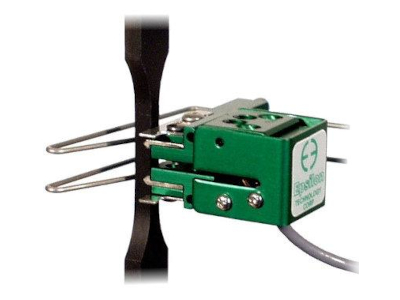
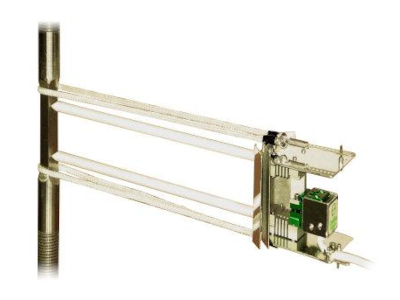
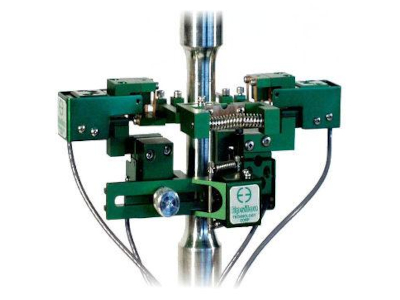
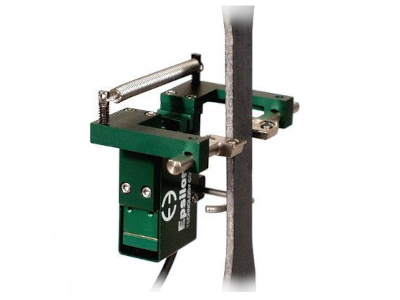
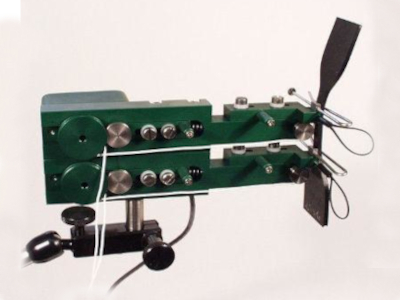
There are two main types of extensometers. These are contact extensometers and non-contact extensometers. Contact extensometers include clip-on and sensor arm devices, which are commonly used for direct measurement on specimens. Non-contact extensometers utilize laser or video technology to measure strain, making them ideal for sensitive or delicate samples. The selection of the appropriate extensometer depends on the properties of the sample, such as size and sensitivity to contact.
Selecting the appropriate extensometer requires knowledge of the different types available. Contact extensometers are generally more straightforward and cost-effective, while non-contact extensometers offer higher precision and are better suited for delicate materials.
The following subsections explore the unique features and applications of each type of extensometer.
Clip On Devices
Clip-on extensometers are recognized for their affordability. They are also noted for their user-friendly design and impressive accuracy. These devices attach directly to the test specimen, providing direct measurements of elongation or compression. They are widely used in various testing scenarios due to their simplicity and reliability.
Despite their advantages, clip-on extensometers can sometimes be time-consuming to set up and prone to operator error, particularly when dealing with fragile specimens. However, their affordability and effectiveness make them a popular choice for many applications, especially in environments where high throughput is not a critical requirement.
Laser Extensometers
Laser extensometers provide precise strain measurements by using laser reflections off the specimen’s surface. These devices use laser light to create a speckle pattern on the specimen surface, allowing for accurate measurements without the need for marking. This non-contact method eliminates errors associated with physical attachment, making laser extensometers ideal for high-precision applications.
The technology behind laser extensometers involves illuminating the specimen surface with lasers and measuring the reflected light to determine strain. This optical measurement method enhances accuracy and is particularly useful for materials that are sensitive to contact.
Additionally, laser extensometers can operate effectively without a receiver behind the specimen, simplifying the measurement setup.
Video Extensometers
Video extensometers utilize digital imaging technology to capture changes in specimen length with high accuracy. These devices use high-resolution cameras and advanced image processing to measure strain, making them suitable for a wide range of materials and testing conditions.
The use of video extensometers ensures high accuracy in materials testing through advanced technology. They are particularly effective for brittle materials or those that release energy during failure, as they can measure multiple points simultaneously. This capability allows for real-time analysis and can be adjusted for both longitudinal and transverse strain measurements, providing comprehensive data on material behavior.
Key Parameters of Extensometers
Several key parameters determine the performance of an extensometer, including gauge length, measuring range, and temperature requirements. ISO and ASTM standards detail specimen dimensions to ensure accuracy in strain measurement during various load applications. These parameters collectively define an extensometer’s effectiveness in material testing applications. Selecting the right extensometer for specific testing needs requires an understanding of these parameters.
The gauge length is a critical parameter that influences the performance of an extensometer, impacting the measurements of strain and other material properties. The measuring range is equally vital, defining the maximum strain that can be measured, which is essential for accurate testing across different materials.
Temperature requirements can significantly affect extensometer performance, necessitating careful specification of temperature conditions to ensure data accuracy.
Initial Gauge Length
Gauge length refers to the distance between the initial measuring points on the specimen and is essential for accurate measurements. Establish this distance according to ISO or ASTM guidelines for consistent results. Setting the initial gauge length impacts measurement accuracy, particularly in tensile testing.
Establishing extensometer’s initial measuring points at specific increments, such as 10 µm, is often part of the calibration process to verify accuracy. Additional calibration steps may be necessary at both the start and end of a testing procedure to ensure consistent results, especially for tensile modulus testing. These steps are essential for confirming reproducibility and ensuring that the extensometer meets the required standards.
Measuring Range
The measuring range of an extensometer indicates its capacity to measure strain or deflection in both tension and compression. This range is crucial for accurately capturing the extent of strain in different materials and testing scenarios. Selecting an extensometer’s measuring range based on the maximum strain expected during testing is critical for obtaining reliable data.
Different materials require various measuring ranges, and understanding maximum strain is essential for selecting the appropriate extensometer for specific testing applications. The measuring range encompasses the maximum strain that an extensometer can accurately detect, which varies depending on the specific testing needs for different materials.
Temperature Requirements
The operational temperature for extensometers is significant as it can affect measurement accuracy and instrument performance. Knowing the test temperature range is crucial for accurate strain measurements during the testing process. Temperature can significantly affect the performance of an extensometer, necessitating careful specification of temperature limits for accurate measurements.
Extensometers must be capable of operating effectively within the specified temperature range relevant to the material being tested. For example, laser extensometers can operate in extreme conditions, measuring strains at temperatures ranging from -80 °C to +2,000 °C. Ensuring that extensometers are specified for particular temperature ranges is crucial for their optimal function during testing.
Interfacing Extensometers with Materials Testing Machines
Laser extensometers can connect to various testing machines and data acquisition systems through a ±10V analog output or bi-directional RS-232 serial port. This flexibility allows for seamless integration with different testing setups, enhancing the efficiency and accuracy of measurements. The configuration of laser extensometers allows for local or remote operation, providing flexibility in testing setups.
Digital communication for laser extensometers includes standard RS-232 serial communications with selectable baud rates for data transmission. This capability ensures that data is accurately transmitted and recorded, facilitating precise analysis and reporting. By interfacing extensometers with testing machines, users can achieve a comprehensive understanding of material behavior under various conditions.
Calibration and Verification
Calibration and verification are essential processes for ensuring the accuracy and reliability of extensometers. Calibration involves adjusting the extensometer to align with a known reference standard, ensuring that the measurements are accurate. Regular maintenance and calibration are necessary to maintain the accuracy and performance of extensometers.
Verification methods are employed to validate that the measurements taken post-calibration are accurate and reliable. One method involves checking that measured deviations during calibration stay within a stringent tolerance of 1 µm. Additional calibration steps are taken during verification to ensure extensometers’ accuracy by evaluating measurement deviations within stringent limits.
Calibration Process
The calibration process involves adjusting an extensometer to align with a known reference standard to ensure measurement accuracy. This process includes verifying accuracy at specific early measurement points, such as a 10 µm threshold in tensile tests. Establishing initial calibration points is critical for early measurement accuracy, ensuring that the extensometer provides reliable data throughout the testing process.
Regular calibration is necessary to maintain the accuracy and reliability of extensometers. Adhering to a consistent calibration schedule ensures extensometers remain precise and dependable, providing accurate data for material analysis and quality control.
Verification Methods
Verification methods confirm measurement accuracy by comparing recorded data against known standards after calibration. These methods ensure that the measurements taken post-calibration are accurate and reliable, validating the extensometer’s performance. Verification methods include checking that the measured values deviations during calibration remain within a stringent tolerance of 1 µm.
Additional calibration steps may be necessary to confirm the accuracy of extensometers, particularly when dealing with critical measurements. By employing rigorous verification methods, users can ensure that their extensometers provide reliable data, enabling precise material analysis and quality control.
Practical Applications of Extensometers
Extensometers play a crucial role in materials testing, particularly in tensile tests conducted with a tensile testing machine, where they provide precise measurements of material deformation. Measuring stress strain curves is essential for evaluating materials in various engineering designs, ensuring accurate and reliable results for safety-critical applications.
These devices are indispensable for measuring the elongation of materials under tensile stress, helping to determine various important material properties such as:
-
tensile modulus
-
Young’s modulus
-
yield point
-
strain at break
By accurately measuring these parameters, extensometers enable engineers to accurately measure material properties and assess the performance and reliability of different materials.
Extensometers are versatile tools that can be used on a wide range of materials, including metals, plastics, fibre-reinforced composites, elastomers, films, textiles, ropes, paper, and wood.
Video extensometers, in particular, offer high accuracy and flexibility, making them ideal for testing brittle or thin materials. These devices can measure multiple points simultaneously, providing comprehensive data on strain distribution across a specimen. Whether for research and development or quality control, extensometers are essential for making critical measurements that inform material selection and product design.
Common Challenges and Solutions
One common challenge when using extensometers is obtaining accurate data due to inaccuracies caused by physical attachment to specimens. This issue is particularly prevalent in high-stress applications where the contact between the extensometer and the specimen can introduce errors. To mitigate these inaccuracies, non-contact extensometers, such as laser and video extensometers, can be used. These devices eliminate the need for physical attachment, thereby reducing measurement errors and enhancing accuracy.
Using clip-on extensometers can also be time-consuming and prone to operator error, especially when dealing with fragile specimens. To improve throughput and accuracy, consider alternatives to clip-on extensometers that reduce setup time and minimize handling errors.
Selecting the appropriate extensometer measuring system for the specific testing application helps overcome challenges, ensuring reliable and accurate measurements.
Let us help you work through these challenges, contact us for help.
Summary
Throughout this guide, we’ve explored the essential role of extensometers in materials testing. From defining what extensometers are and how they measure strain, to delving into the different types and key parameters, we’ve covered all the critical aspects that make these devices indispensable for accurate material analysis. Extensometers help determine important material properties, ensuring that materials meet the required performance standards.
In conclusion, understanding the functionality and applications of extensometers is vital for engineers and researchers involved in materials science and mechanical testing. By selecting the right extensometer and ensuring proper calibration and verification, users can achieve precise, reliable measurements that drive innovation and quality in various industries. Whether you’re testing metals, plastics, or composites, extensometers provide the data needed to make informed decisions and advance material technology.
Frequently Asked Questions
An extensometer is employed to measure the extension or elongation of a specimen under load, yielding vital data on strain and material properties. This measurement is essential for understanding the material's behavior under stress.
Extensometers are classified into contact types, including clip-on devices, and non-contact types, such as laser and video extensometers. Understanding these categories is essential for selecting the appropriate device for specific measurement needs.
Gauge length is crucial in an extensometer because it defines the specific distance over which strain is measured, ensuring accurate results in line with established standards such as ISO or ASTM. Accurate strain measurements are vital for understanding material properties and performance.
Laser extensometers measure strain by directing lasers onto a specimen's surface and analyzing the reflections, which minimizes contact errors and improves accuracy.
Common challenges when using extensometers include potential inaccuracies from physical attachment to specimens and the setup time required for clip-on models. Utilizing non-contact extensometers and ensuring a proper setup can effectively address these issues.
