
Blog
- Details
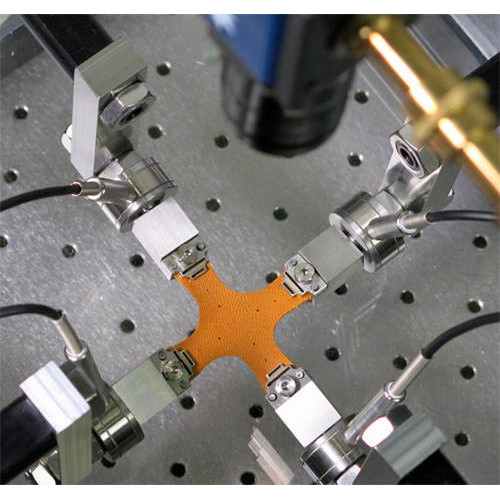
You might be wondering where to even begin to configure a planar biaxial test system. There are just so many factors and so many options. You might feel like you hit a brick wall. Luckily we can help. We understand that your test application can be very unique and the “standard” products that are available just won't do. You may be surprised to discover that our test system modularity makes it possible to configure a solution to meet even the most unique aspects and challenges of your application. The more we know your application’s technical specifics the more likely we can satisfy your requirements quickly. In that spirit it helps us respond better when you share as much application information as possible.
Here are some example questions that we ask our customers when determining the best solution:
Q: What is the main reason you need a test machine?
Q: What are the different types of material or components to be tested?
Q: What types of tests are to be performed?
Q: What do you think is the maximum actuator stroke required (of each actuator)?
And more.
Compare Our Solutions with Other Brands of Test Machines
If you are looking to invest in a planar biaxial test system make sure you are getting the highest return on your investment by asking us to compare the differences between our solutions and those of our competitors including TA Instruments Bose electroforce Enduratec Cellscale Biotester Zwick and Instron. Compare us with the competition before making a decision.
We can provide you a specific proposal and additional information about planar biaxial test machines biomaterials testers or biomedical test machines. Give us a call today and if possible please take a moment to share a little information regarding your test plan including test sample sizes material types loading requirements etc. You can print out the PDF questionnaire and fax it (with your answers and contact information) to 1-952-516-5391. Otherwise you can submit your answers to us here.
Contact us with or without answers to the list of questions above. Together we can define your testing requirements and arrive at a product configuration and solution.
- Details
This is a commonly asked question.
To begin, ASTM and ISO industry test standards for materials such as plastics, rubber, steel and composites tend to require or strongly recommend an extensometer to measure strain values when the test data is used to validate critical engineered designs.
To the user, the implications of providing an axial extensometer to a new test machine purchase add approximately $3000 higher cost for the extensometer and controller strain channel.
To contrast, the crosshead movement or stroke of a universal test machine or electromechanical actuator is measured by the digital position encoder that is included as part of the mechanical assemble and can typically measure with submicron resolution possible. Crosshead position movement is not the same as mechanical sample based strain but in certain applications the crosshead movement measured by the encoder can be even more accurate than an extensometer at least when the load train is unloaded or loads are small.
An extensometer measures true sample strain independent of sample loading. Higher or lower load values do not influence the strain measurement of an extensometer which is in contrast with use of the encoder that is subject to system compliance or loading considerations.
If compliance of your specimen is 100 times more than the compliance of the load frame and the load string components you can assume that the reported crosshead movement is equivalent to the deflection experienced by the specimen – as a general guideline.
Another way to approach the challenge of capturing inexpensive sample position data is to measure system compliance prior to the test by installing a stiff sample and applying a tensile load. Measure the resulting deflection measurement. When you test with a real test specimen remove the deflection values from the results.
Compliance refers to the stiffness of the test frame related load train components and test sample under loading. Note that when a load is applied to a load train component such as crosshead it deflects. It acts as a very stiff spring and although the deflection is small it is measurable. Compliance if the opposite of stiffness.
Load train compliance is usually unknown because of the large combination of different test fixtures grips and machines that do not have published compliance data.
Next time consider the cost of adding an extensometer to a purchase decision may be an easier decision assuming you have a clear test sample (geometry dimensions and material properties) in mind.
- Details
The 510k approval process is a high stakes, high stress rush to the finish. In the crush of all that needs to be done, your testing plan is often put off until the end. And as a result, it is not unusual for us to talk with engineers in a panic about the duration of the fatigue tests required by the FDA.
A little planning upfront can prepare you to meet the testing challenges even if the FDA surprises you with tests you were not expecting.
Your 510k testing plan: Safety and efficacy
In the FDA’s words: “A 510(k) is a premarket submission made to FDA to demonstrate that the device to be marketed is at least as safe and effective, that is, substantially equivalent, to a legally marketed device”, or predicate device. You must present data for both safety and efficacy. In most cases, this means rigorous testing of your new device AND the predicate device. And of course, the FDA wants to see a statistically significant set of test data for both devices.
Factors that determine test time:
- Do you need to test the predicate device or can you rely on existing data?
- How many devices do you need to test?
- How many tests do you need to run?
- The number of cycles and test speed affect the length of time required for each test
- Start planning your testing early in your process
Early evaluation of predicate device data is critical to planning your testing schedule. A predicate device is an existing product in the marketplace with approval from the FDA. The 510k process allows similar devices to demonstrate that they are substantially equivalent provided the test data supports the claims of equivalency and efficacy. This is the essence of a 510k.
Selection of the predicate device
If you can, choose a predicate device that has published data on it. If you can verify that the tests were performed according to current standards recognized by the FDA, (e.g. ASTM F2077 for spinal products, IS0 10555 for catheter products) you may be able to use that data in lieu of running tests on the predicate device. Information on predicate devices can be found on the FDA web site.
If published data is not available and you have to run your own tests on the predicate device, choose one that is readily available. A device may have limited or controlled distribution. Your competitors are not eager to supply you with products, so don’t wait until the last minute to acquire the devices you will need for testing.
Another option to predicate testing: testing to approved standards
Another option is to conduct your test plan according to recognized consensus standards. Since 1998 the FDA has allowed some medical devices that pass specified tests, approval without requiring comparative testing with predicate devices. Obviously this can be a large time saver.
How many devices do you need to test?
- The only answer that matters is what the FDA says about your specific situation—but in general there are rules of thumb that apply.
- The less the data scatter on previous testing of the predicate the fewer number you need to test to achieve statistically significant results
- The lower the data scatter on your device the fewer the number you need to test. Early testing on your device to determine the scatter can save you panic later on.
- It is wise to perform as much testing as possible prior to formal 510k testing to avoid surprises because surprises experienced during formal 510k tests must be explained in the submission document.
How many tests will you need to run?
Again the only opinion that matters is the FDA’s. We have seen where predicate testing included additional tests that engineers did not think were applicable for their product. The FDA disagreed and required it anyway.
510k test data must go according to plan. Therefore it is wise to run practice tests to confirm that the tests you run for submittal will not have any surprises. For example, you do not want to have fixture problems in your submittal data. Although this takes more time, especially with long-duration fatigue tests, it will probably save time in the overall approval process because clean test data with low scatter minimizes the risk of the FDA requesting more testing.
In our experience the number of tests required to create an accurate S-N curve is commonly about 5 to 12 for each fatigue test. But this is in no way certain for your device. It is wise to discuss the number of tests with the FDA because each test can take several days can have a significant effect on time to market.
How long will each test take?
If you are not used to fatigue testing you might be surprised how quickly weeks of testing time per specimen can easily turn into months to complete the required number of specimens for both the new device and the predicate device.
It is our experience that most tests are run to a relevant standard such as ASTM F2077. Determine which standards apply to your product and calculate the time required for each test.
Example: Calculating test time
Let’s say we are seeking 510k approval for a spinal fusion device and testing to ASTM F2077. Working with the FDA we have determined we need 5 stress levels to make our S-N curves. That means 5 tests for each curve times two products (predicate and new) x 3 tests (ASTM F2077) calls for compression, compression/shear, and torsion) = 30 tests. Each test will take 5,000,000 cycles or failure whichever comes first. That’s about 12 days per test at 5 hz if all goes well.
That’s about 1 year of round the clock testing time if you are using one fatigue test machine.
Fatigue cycles and frequency
It is our experience that orthopedic tests are usually run at about 5 hz. Higher frequencies run the risk of generating heat which can invalidate the tests. Some argue they can run up to about 10 hz.
Your contingency plan
No matter how careful and reasoned your approach the final approval decision on your testing plan lies with the FDA. At the last minute they can and do add additional test requirements you must perform. When this happens you will be miles ahead of the game if you have a contingency plan in place.
Will the FDA require additional tests after your first 510k submittal?
It is our experience that often the FDA responds with requests for more tests. You then have 3 months to respond to ensure a quick review by the FDA; longer than that and you may get pushed to the back of the line costing you further delays (6 months or longer) in your time to market.
Our recommendation is that you have adequate testing capacity in place until you get final approval from the FDA.
510k path to FDA approval can go well if it is planned and managed well.
We have seen many 510k submittals finish on schedule despite the many challenges described above and all of them share the same process. They all had a testing plan that started with early review/recommendations with the FDA, all knew early how long each test would take, and they ran practice tests to avoid surprises in their 510k submission.
TestResources can help, not only with excellent test equipment but also with advice. We look forward to working with you!
- Details
Yes. Cyclic tests are possible depending on your test machines maximum test speed and the amount of sample compliance or stiffness. Most of our universal test machines can perform tension-tension and compression-compression tests at speeds up to 2 hz, assuming your test samples are relatively stiff. Operating faster than 2 hz becomes inefficient for an electromechanical test machine and can harm your servo motor.
The test waveform in cyclic applications depends on the controller type and the test speed. A sinusoidal or triangular control waveform is possible using our high speed PC based R Series controller. Our simpler and lower cost Q Series controller can produce a triangular waveform (not sinusoid) where the crosshead moves at constant speed between either load or position limits.
If you want higher test frequency or your sample has high stretch extension, then consider our electrodynamic test machines or servo hydraulic fatigue test machines which can deliver both higher speeds and higher loads at the same time. Also our fatigue test machines can handle higher loads without causing damage to the load frame components. Note that universal test machines are not designed for heavy usage as fatigue machines.
To learn more, contact an applications engineer who can help you sort out the best solution for your needs.
More Articles …
- Five Big Differences Between Electrodynamic and Servo Hydraulic Fatigue Test Machines.
- Making Dogbone Tensile Test Samples
- Comparing Tension Testing to Tensile Testing
- Tensile Stress Strain Curve
- The Difference between Tensile Test and Compression Test Equipment
- Tensile Test Properties
- Is a THREE Point Test the Same as a THIRD Point Test?
- Differences Between Three Point and Four Point Bending Tests
- Similarities Between a Flexural Test and Tensile Test?
- Is a THREE Point Test the Same as a THIRD Point Test?
- Why Not to Use a Handheld Force Gauge on a Peel Test
- Measuring the Modulus of Elasticity When Testing Plastics
- The Challenge of Testing Tiny Test Samples
- Differences Between a Flexure Test and Bend Test
- Typical Flexure Test Sample Geometry
Need Help?
Talk to one of our Application Engineers to help you find the right solution for your test applications

When you work with us, you get the best engineers to solve your testing and budgetary challenges. Whether you’re new to testing or a testing expert yourself, we can help you optimize your system AND YOUR BUDGET.
Contact us and see for yourself why TestResources is the best choice for your testing needs!